This is the blog of the project "Neo-Innova: The diffusion of Neolithic in the Central-Western Mediterranean: agriculture, technological innovations and radiocarbon dating" (HAR2016-75201-P). This research project focuses on one of the main turning points of human history: the diffusion of Neolithic. Even if it is well established that the Near East was the first focus of the invention of farming, around X-IX milenium BC, the mechanisms and the paths of its spreading in the rest of the Mediterranean are yet to be unfolded. During the last decades, the origin of European Neolithic has been explained as result of a diffusion process through two main axes: a Northern one, crossing central Europe, and a Southern one along the Mediterranean coasts. The current project is aimed to analyse the process of Neolithic diffusion through the Central-Western Mediterranean through analysis of the techniques and tools associated with the crop-harvesting and -processing tools. Analysis of those tools has to be supported by an extensive program of radiocarbon dating and a cross-analysis of the crop-harvesting/14C with the information proceeding from the environmental/ecological, the technological and the cereals consumed.

Showing posts with label Harvesting techniques. Show all posts

Thursday, 3 May 2018

Studying La Dehesilla tools (Cádiz, Andalusia)

For several weeks we have been working in the Neolithic settlement of La Dehesilla (Cádiz, Andalusia). This is one of the most well-known sites in the South of Spain. Is was excavated at the end of the 20th century by Manuel Pellicer and Pilar Acosta, and recently taken up by Daniel Garcia Rivero (University of Seville).


The results will help us to know the tooling of the first Neolithic communities of the SW of the Iberian Peninsula, of which we had very little information.


More information in:http://institucional.us.es/evocultura/dehesilla/index.php?page=historiografia

Professor Pellicer has recently died. From this blog we thank you for your excellent work


Thanks also to Daniel Garcia for being able to work with him in the study of the materials found in the last excavations

New papers on a monograph about Neolithic expansion

With enthusiasm, we present the monograph that we recently published in the journal Quaternary International. Under the title of The Neolithic expansion in the Western Mediterranean: Understanding a global phenomenon from regional perspectives.


Edited by Juan F. Gibaja, Juan J. Ibáñez, Niccolò Mazzucco and Xavier Terradas, several researchers of the project have collaborated in the edition and publication of some of the articles:

The beginning of the Neolithic in the Po Plain (northern Italy): Problems and perspectives Original Research Article
Pages 301-317
Elisabetta Starnini, Paolo Biagi, Niccolò Mazzucco

Mesolithic-Neolithic transition in the northeast of Iberia: Chronology and socioeconomic dynamics Original Research Article
Pages 383-397
F. Xavier Oms, Xavier Terradas, Berta Morell, Juan F. Gibaja


When the Mediterranean met the Atlantic. A socio-economic view on Early Neolithic communities in central-southern Portugal Original Research Article
Pages 472-484
António Faustino Carvalho

Harvesting tools and the spread of the Neolithic into the Central-Western Mediterranean area Original Research Article
Pages 511-528
Niccolò Mazzucco, Giacomo Capuzzo, Cristiana Petrinelli Pannocchia, Juan José Ibáñez, Juan Francisco Gibaja


From this blog we offer our greatest congratulations to all the authors who have collaborated.

Studying sickles in Thessaloniki

At the beginning of April, we travelled to Thessaloniki for a collaboration with Foteini Adaktylou and Maria Pappa to analyze the Neolithic tools of the settlements of Revenia and Makriyalos.

We have been able to study a small number of pieces from both sites since the archaeological record is enormously rich. The data obtained is excellent and helps us understand the Neolithic sickles of Northern Greece.

It has been great to be able to collaborate with Foteini and María, as well as with the curators and technicians of the Makriyelos Museum and Angeliki Kita, to whom we thank for their help.

In June we will return to Thessaloniki to continue working on new deposits. This will allow us to complete our knowledge about these Neolithic lithic tools.


Museum of Makriyalos. Wonderful to work! 

In front of Mount Olympus

Thursday, 1 February 2018

The Neolithic Sickles in the Republic of Macedonia

These days we had the opportunity to study the sickles of several Neolithic sites in the Republic of Macedonia.

The results are enormously interesting because of the links with other Neolithic manifestations of neighbouring areas.
This work is only a first step for new jobs that will start soon.
All this has been thanks to the collaboration of Goce Neumov, Fidanoski Ljubo, Aleksandar Mitkoski and other colleagues from City Museum of Skopje, Archaological Museum of Prilep and Archaeological Museum of Stip. 

From this post we thank you. It has been fantastic to share with great professionals and now friends this unforgettable experience.

Sickles f Govrlevo site 

 Niccolo Mazzucco and Juan Gibaja

Niccolo Mazzucco presenting our project at the Museum of Skopje 

 Fidanoski Ljubo presenting Niccolo Mazzuco

Goce Neumov presenting our project and collaboration

Archaeological Museum of Stip

Niccolo Mazzucco working in the Museum of Skopje

Museum of Macedonia

Goce Naumov and Niccolo Mazzucco in the Archaeological Museum of Prilep

Niccolo Mazzucco working in he Archaeological Museum of Prilep 

Wednesday, 3 January 2018

New Paper in Arkeogazte


We are happy to present a new paper that has been published in Arkeogazte journal. It is a final revision of the data we currently have on the Neolithic sickles from Italy to Portugal.

Authors: Juan F. Gibaja, Niccolo Mazzucco, Juan José Ibáñez, Mario Mineo, Amelia Rodríguez, Bernard Gassin, Unai Perales, Ignacio Martín-Lerma and Cristina López-Rodríguez


(Click on tittle to download)


Wednesday, 25 October 2017

Back in Greece! Neo-Innova project studying early farmers in Crete and Boeotia

Within the frame of the Neo-Innova project we have been back in Greece, working on the flaked stone tool assemblages from Knossos in Crete and Sarakenos cave in Boeotia. Results have been exciting and new data on harvesting technology diffusion and evolution have been gathered. The picture is getting clearer!

We would like to thank all the people that made this study possible, for their kindness and support: Valasia Isaakidou, Amy Boogard, Paul Halstead, Maria Ntinou, James Conolly, Paul Halstad, Christina Tsorakis, Adamantios Sampson, Tonia Tsourouni, ... and many others.


In Knossos.


At work... analising Sarakenos Cave tools.


View of the Gla village, an important fortified site of the Mycenaean civilization.

Wednesday, 6 September 2017

Moisson et dépiquage expérimentaux (Bernard Gassin)

Une expérimentation de moisson et de dépiquage de Triticum monococcum a eu lieu du 27 au 30 août 2017 à Séranon, dans les montagnes de l’arrière-pays des Alpes Maritimes. Ces expériences permettent de documenter la variabilité des usures des faucilles selon les emmanchements et la morphologie des faucilles et des éléments de tribulum. On a ainsi testé deux emmanchements de lames uniques selon des modalités connues ou supposées pour le Néolithique ancien et moyen de Méditerranée occidentale, en oblique (type La Draga) et en parallèle dans un manche courbe.

Nous avons également testé un emmanchement en série de lames larges denticulées, selon un modèle de l’âge du Bronze en Grèce. Ce même type de lame a été également testé sur un modèle de tribulum élaboré par P. Anderson (CEPAM, CNRS, Nice) pour répliquer et tester des tribulums de Mésopotamie.

La moisson, le dépiquage, par piétinement et hachage au tribulum, et le vannage, permettent également de documenter un référentiel pour l’analyse des phytolithes (travaux J. F. Gibaja, thèse en préparation S. Alkalesh). Cette session expérimentale poursuit les travaux menés depuis des années par P. Anderson, notamment dans le cadre du programme EARTH, et a bénéficié cette année du soutien du programme “La difusión del neolítico en el Mediterráneo centro-occidental: agricultura, innovaciones tecnológicas y carbono 14” (Diffusion of Neolithic in the Central Western Mediterranean: agriculture, technological innovations and 14C).

Equipe : Patricia Anderson (CEPAM, Nice), Souhair Alkalesh (CEPAM), Bernard Gassin (TRACES, Toulouse), Marie Montagné (LAMPEA, Aix-en-Provence), Mondher Mhamdi (Université de Kairouan, Tunisie).


Saturday, 8 July 2017

New Article on Neolithic Harvesting technologies!

We are proud to present a new article on the Neolithic harvesting technologies:


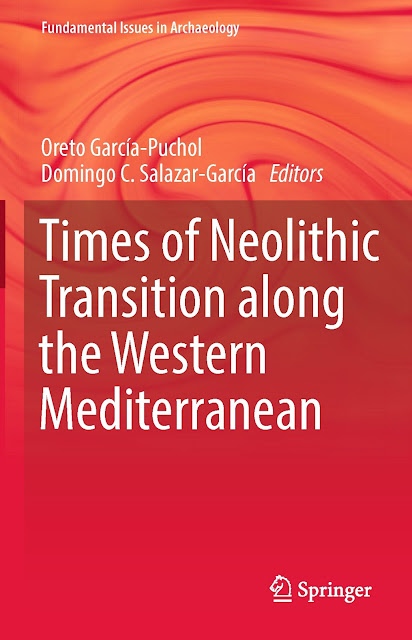
This article, authored by Ibáñez, J.J., Gibaja, J.F., Gassin, B. and Mazzucco, N., is part of a recently published book: "Times of Neolithic Transition along the Western Mediterranean" edited by Oreto García-Puchol and Domingo C. Salazar-García. 

Thanks to everybody that made this study possible!