This is the blog of the project "Neo-Innova: The diffusion of Neolithic in the Central-Western Mediterranean: agriculture, technological innovations and radiocarbon dating" (HAR2016-75201-P). This research project focuses on one of the main turning points of human history: the diffusion of Neolithic. Even if it is well established that the Near East was the first focus of the invention of farming, around X-IX milenium BC, the mechanisms and the paths of its spreading in the rest of the Mediterranean are yet to be unfolded. During the last decades, the origin of European Neolithic has been explained as result of a diffusion process through two main axes: a Northern one, crossing central Europe, and a Southern one along the Mediterranean coasts. The current project is aimed to analyse the process of Neolithic diffusion through the Central-Western Mediterranean through analysis of the techniques and tools associated with the crop-harvesting and -processing tools. Analysis of those tools has to be supported by an extensive program of radiocarbon dating and a cross-analysis of the crop-harvesting/14C with the information proceeding from the environmental/ecological, the technological and the cereals consumed.

Wednesday, 24 May 2017

Neolithic Sickles from Portugal

A few days ago we travelled to Lisbon for studying a series of Ancient Neolithic sites in Portugal. The results have been great, as we were able to obtain relevant results from three different sites, some of which have nor been ever published (then, the data about them is still unpublished).

We want to say thanks to Antonio Faustino Carvalho and Joao Cardoso because it was due to their good dispositions that we were able to study the sites of Pedreira de Amoreiras, Gafanheira and Carrascal.

The results will complete the ongoing image about the first Neolithic sickles in the westernmost area of the Mediterranean basin.

We want to say thanks, also, to Antonio, Joao and all our friends at Centro de Estudos Arqueológicos sited on Fábrica da Pólvora.


Colloque Internacional RPA: Les Rencontres préhistoriques d’oued el Akarit

We recently took part in the first “Colloque Internacional RPA: Les Rencontres préhistoriques d’oued el Akarit” where, thanks to our colleagues L. Belhouchet, R. Khedhaier, N. Aouadi, H. B Sghari, H. Lakhal-Nasfi y H. Mekki, we presented a poster entitled Neo-Innova : The diffusion of Neolithic in the Central-Western Mediterranean: agriculture, technological innovations and radiocarbon dating" (HAR2016-75201-P): Tracing back the first farming communities of the Mediterranean by the analysis of agricultural tools

With such a work, we wanted not only to show our project’s objectives but to transmit to the attendees our interest in studying Tunisian archaeological sites. We believe it is a hugely interesting area, especially for the explanations about the neolithization of north-western Africa.

Rym Khedhaier presented the poster:


We want to especially thank Lofty, Hella, Rym and Baya for their help!


Monday, 8 May 2017

New Article: Harvesting Tools and the Spread of the Neolithic into the Central-Western Mediterranean Area


A new article has been recently published!

Mazzucco, N.,  Capuzzo G., Petrinelli Pannocchia C., Ibáñez J.J., Gibaja, J.F. Harvesting tools and the spread of the Neolithic into the Central-Western Mediterranean area, Quaternary International (2017), http://dx.doi.org/10.1016/j.quaint.2017.04.018

This paper discusses the current state of research on harvesting technologies of the first farming communities of the central and western Mediterranean area between ca. 6000-5900 cal BC and 4800-4700 cal BC. New data obtained from the analysis of almost 40 sites from the Italian Peninsula is compared with data previously collected from the Iberian Peninsula and southern France. Results indicate the existence of at least two different harvesting traditions, one characterized by curved sickles used for harvesting at a low or middle height; the other characterized by reaping knives with parallel hafted blades, probably mainly used for ear harvesting. Processes of innovation and change have been highlighted, suggesting that harvesting techniques changed and evolved through time. Besides, the mechanism and pace of diffusion of curved sickles have been explored, too.


We would like to express our gratitude to those colleagues who are participating in this project, allowing and helping us to analyze the sickle elements which are the basis of this study: D. Arobba, L. Baglioni, M. Baioni, P. Biagi, P. Boccuccia, F. Briois, F. Cavulli, M. Colombo, C. Conati Barbaro, A.M. De Angelis, S. Forenbaher, J. Guilaine, S. Grimaldi, S. Kacar, C. Lemorini, C. Longhi, V. Leonini, D. Lo Vetro, F. Martini, D. Mengoli, A. Moroni,I.M. Muntoni, A. Pedrotti, C. Perlés, A. Pessina, G. Radi, A.M. Ronchitelli, M. Serradimigni, F. Santaniello, P. Schirolli, E. Starnini, L. Sarti, G. Steffé, U. Tecchiati, I. Tirabassi, C. Tozzi, A.M. Tunzi, P. Visentini, M. Venturino Gambari and B. Voytek. This research is the result of three integrated projects: “The Diffusion of the Neolithic: Agricultural Technologies and Innovations in the Central Mediterranean Area” funded by a post-doctoral grant by the Fyssen Fondation and the collective projects “Le temps des moissons: l'arrivée des premiéres communautés d'agriculteurs en méditerranée centrale” funded by the Maison Archéologie & Ethnologie, René-Ginouvés and “La difusión del neolítico en el Mediterráneo centro-occidental: agricultura, innovaciones tecnológicas y carbono 14 - HAR2016-75201-P” funded by the Spanish Ministry of Economy and Competitiveness. Additional financial aid has been provided by the UMR 7055 «Préhistoire et Technologie»; a special thanks goes to them, for their help and support in this project. Special thanks also go to Giacomo Gonella for the revision of the manuscript.

Wednesday, 5 April 2017

New publication: Harvest time: crop-reaping technologies and the Neolithisation of the Central Mediterranean


We are pleased to present a new publication recently appeared in Antiquity.

Mazzucco, N., Guilbeau, D., Petrinelli-Pannocchia, C., Gassin, B., Ibáñez, J., & Gibaja, J. (2017). Harvest time: Crop-reaping technologies and the Neolithisation of the Central Mediterranean. Antiquity, 91(356). doi:10.15184/aqy.2016.273 


Thanks to all the authors and to the various funding institutions that are making this project possible (Fondation Fyssen, Maison de l'Archéologie et l'Ethnologie René-Ginouvès, Ministerio de Economía y Competitividad)!


Saturday, 18 March 2017

Early Farming Communities in Thessaly: work in progress


Within the framework of our project, we are now in Thessaly at the Diachronic Museum of Larissa for analyzing the materials from various Early, Middle and Late Neolithic sites in order to explore the evolution of the harvesting technologies of the first farming communities of the Thessalian plain.


The entrance of the Diachronic Museum of Larissa


Thessalian plane shows an incredible density of this type of sites, over 300 sites have been surveyed, even if only a small percentage have been excavated. Few areas in Europe has such a density of Neolithic settlements.


One of the labels of the museum with the distribution of the surveyed (yellow dots) and excavated (red dots) Neolithic mounds.


Materials conserved in the Museum are of exceptional relevance for the understanding of the Neolithic diffusion process, with some beautiful examples of clay human figurines.


Some of the materials exposed in the Museum.


The city of Larissa also conserves some relevant monuments from Greek, Byzantine and Ottoman periods, mainly concentrated in the acropolis of the city.

The ancient theater of the city (first half of the 3rd century BC- early 4th century).


We would like to thanks G. Toufeix and C. Mpatzelas for their kindness and their support, C. Perlés for introducing us to Greek Neolithic, E. Alram-Stern for allowing participating in the study of Platia Magoula and L. Papagiannaki and C. Moser for their joyful company and help.


Work in progress...


Friday, 17 March 2017

The Sickles of Nerja Cave (Málaga, Spain)

This week we visited the "Cueva de Nerja" to study the first Neolithic sickles found in the "Mina" sector. Recent excavations are delivering superb results and an excellent contextualization of evidence.

The results obtained complete the information we currently have from the south of the Iberian Peninsula.

This work is inserted in the studies that are being carried out in the cave under the direction of José Luis Sanchidrián and Luis Efrén Fernández.

We thank them for their kindness and collaboration. As well as to Mari Angeles Medina, Cristina, Yolanda, Juan Bautista Salado and all the friends who work in the cave and the museum of Nerja.


Thursday, 9 March 2017

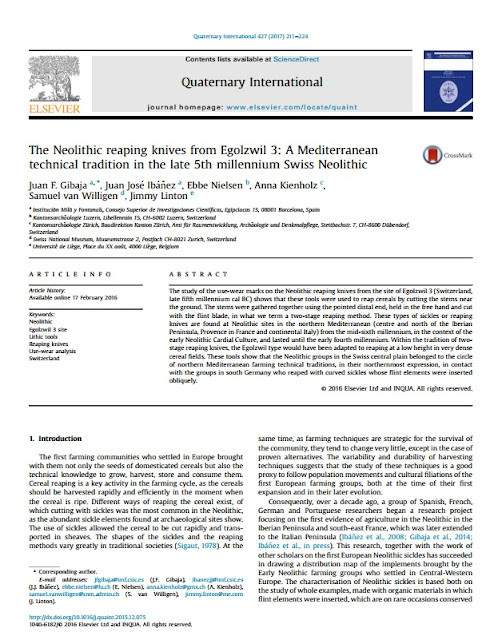
New Paper: The Sickles of Egolzwil 3 (Switzerland)

We present a new paper published in Quaternary International.

Thank you all authors!!!!


The Neolithic reaping knives from Egolzwil 3: A Mediterranean technical tradition in the late 5th millennium Swiss Neolithic.


Working in Pamplona (Navarra): neolithic site of Cascajos

These days we went to Pamplona (Navarra) for studying the Neolithic materials of the Cascajos settlement. The results have been enormously interesting in relation to two different sickle types, which correspond to two differentiated chronological moments.

A previous work by Juan José Ibáñez and Jesus Emilio González, on a sample of these deposits, arrived at the same conclusions. Now we have reviewed all the material.
In order to get this study done, the collaboration of Juan José Ibáñez, Jesus Emilio González, Jesus Sesma, Jesus García Gazólaz, Cristina López and Manuel Rojo has been indispensable.
Millions of thanks to all the people involved.


Friday, 27 January 2017

Session EAA 2017 (Maastrich): "Approaches to Early Farming Systems: diffusion and development of agricultural practices into the Mediterranean - SESSION #285"


We are pleased to invite you to participate to our recently accepted session called: "Approaches to Early Farming Systems: diffusion and development of agricultural practices into the Mediterranean - SESSION #285" within the "23th Annual Meeting of the European Association of Archaeologists" which will be held in Maastricht (The Netherlands), 30 August - 3 September 2017.