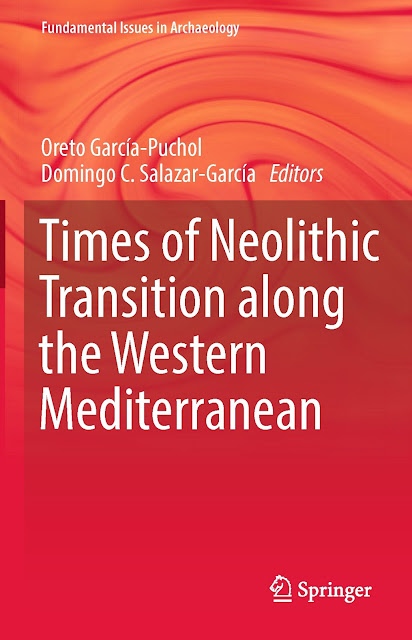
We are happy to present a new paper that has been published in Arkeogazte journal. It is a final revision of the data we currently have on the Neolithic sickles from Italy to Portugal.
This is the blog of the project "Neo-Innova: The diffusion of Neolithic in the Central-Western Mediterranean: agriculture, technological innovations and radiocarbon dating" (HAR2016-75201-P). This research project focuses on one of the main turning points of human history: the diffusion of Neolithic. Even if it is well established that the Near East was the first focus of the invention of farming, around X-IX milenium BC, the mechanisms and the paths of its spreading in the rest of the Mediterranean are yet to be unfolded. During the last decades, the origin of European Neolithic has been explained as result of a diffusion process through two main axes: a Northern one, crossing central Europe, and a Southern one along the Mediterranean coasts. The current project is aimed to analyse the process of Neolithic diffusion through the Central-Western Mediterranean through analysis of the techniques and tools associated with the crop-harvesting and -processing tools. Analysis of those tools has to be supported by an extensive program of radiocarbon dating and a cross-analysis of the crop-harvesting/14C with the information proceeding from the environmental/ecological, the technological and the cereals consumed.
Pages
Wednesday, 3 January 2018
New Paper in Arkeogazte
We are happy to present a new paper that has been published in Arkeogazte journal. It is a final revision of the data we currently have on the Neolithic sickles from Italy to Portugal.
Wednesday, 25 October 2017
New Paper - Tribute to our friend Lydia Zapata
It is certainly a way of recognizing the human and scientific quality of Lydia with which we shared beautiful moments.
You can see in:
Back in Greece! Neo-Innova project studying early farmers in Crete and Boeotia
Friday, 8 September 2017
EAA 2017 Maastricht Conference - "Approaches to Early Farming Systems: diffusion and development of agricultural practices into the Mediterranean - Session #285"
Wednesday, 6 September 2017
Moisson et dépiquage expérimentaux (Bernard Gassin)
Nous avons également testé un emmanchement en série de lames larges denticulées, selon un modèle de l’âge du Bronze en Grèce. Ce même type de lame a été également testé sur un modèle de tribulum élaboré par P. Anderson (CEPAM, CNRS, Nice) pour répliquer et tester des tribulums de Mésopotamie.
La moisson, le dépiquage, par piétinement et hachage au tribulum, et le vannage, permettent également de documenter un référentiel pour l’analyse des phytolithes (travaux J. F. Gibaja, thèse en préparation S. Alkalesh). Cette session expérimentale poursuit les travaux menés depuis des années par P. Anderson, notamment dans le cadre du programme EARTH, et a bénéficié cette année du soutien du programme “La difusión del neolítico en el Mediterráneo centro-occidental: agricultura, innovaciones tecnológicas y carbono 14” (Diffusion of Neolithic in the Central Western Mediterranean: agriculture, technological innovations and 14C).
Equipe : Patricia Anderson (CEPAM, Nice), Souhair Alkalesh (CEPAM), Bernard Gassin (TRACES, Toulouse), Marie Montagné (LAMPEA, Aix-en-Provence), Mondher Mhamdi (Université de Kairouan, Tunisie).
Thursday, 3 August 2017
Analysis of Lithic Tools from Cova d'en Pardo and Cova Randero. Alicante's Archaeological Museum
It was a great experience with excellent results. With these two archaeological sites, we are further completing the studies of Neolithic sites in Valencia region. The results from these recent works will be soon published in a monographic book about Cova d'en Pardo.
Thanks to Gabriel, Laura and Jorge for the friendship and their collaboration; and also thanks to the curators and technicians from the museum for their professionalism and kindness.
Saturday, 8 July 2017
New Article on Neolithic Harvesting technologies!
Wednesday, 24 May 2017
Neolithic Sickles from Portugal
We want to say thanks to Antonio Faustino Carvalho and Joao Cardoso because it was due to their good dispositions that we were able to study the sites of Pedreira de Amoreiras, Gafanheira and Carrascal.
The results will complete the ongoing image about the first Neolithic sickles in the westernmost area of the Mediterranean basin.
We want to say thanks, also, to Antonio, Joao and all our friends at Centro de Estudos Arqueológicos sited on Fábrica da Pólvora.
Colloque Internacional RPA: Les Rencontres préhistoriques d’oued el Akarit
With such a work, we wanted not only to show our project’s objectives but to transmit to the attendees our interest in studying Tunisian archaeological sites. We believe it is a hugely interesting area, especially for the explanations about the neolithization of north-western Africa.
Rym Khedhaier presented the poster:
We want to especially thank Lofty, Hella, Rym and Baya for their help!